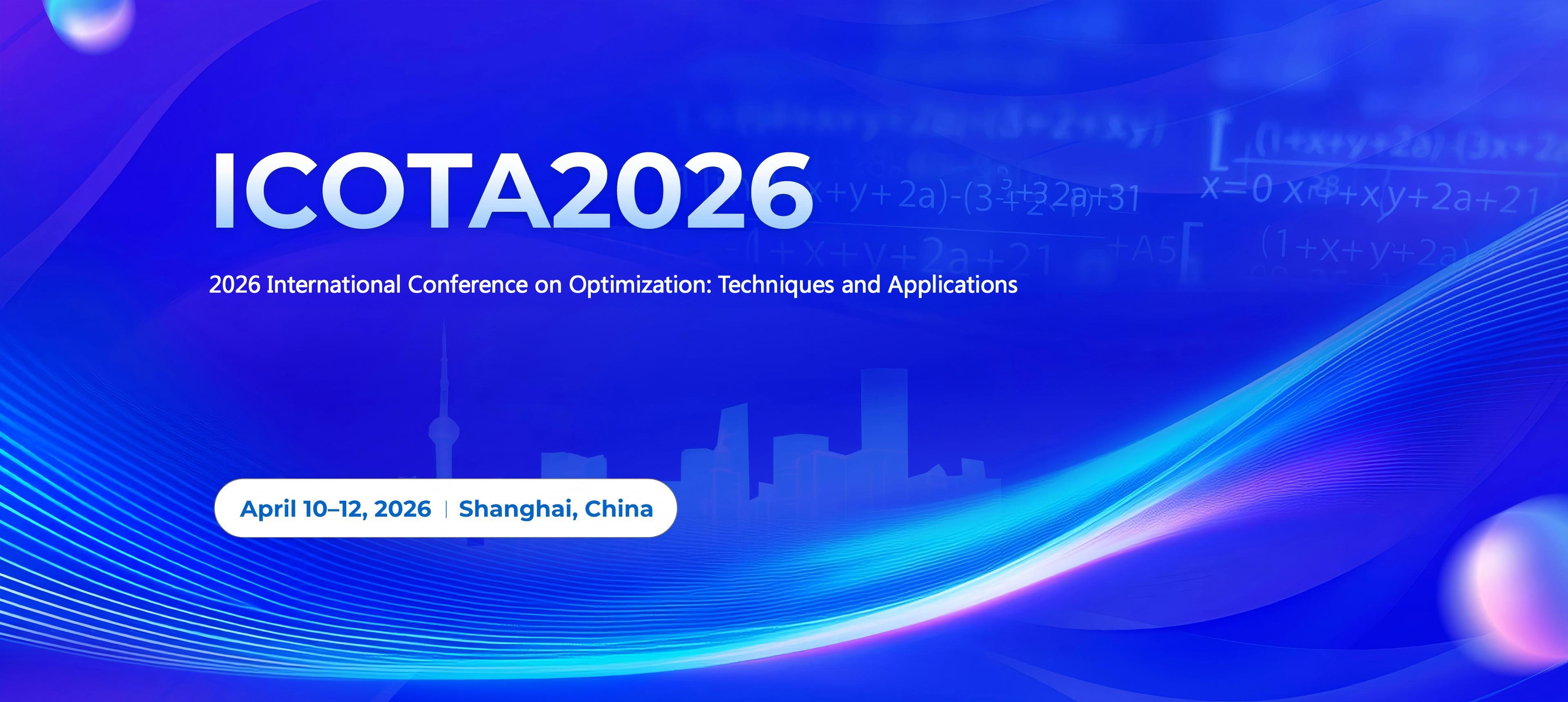
ICOTA has a rich history of bringing together leading researchers, academics, and practitioners in the field of optimization theory and its applications. Since its inception, ICOTA has served as a key platform for sharing innovative ideas, fostering collaborations, and advancing both theoretical and applied research in optimization.
The first two ICOTA conferences were organized in Singapore in 1987 and 1992, establishing the foundation for what would become a recurring international forum. Following these early successes, ICOTA transitioned into a structured and highly respected conference series, guided by a dedicated steering committee to ensure continuity and scientific excellence. The third ICOTA conference took place in Chengdu, China, in 1995, followed by the fourth ICOTA in Perth, Australia, in 1998. These conferences helped expand the reach of ICOTA to the Asia-Pacific region and attracted participants from a growing number of countries. The series continued to flourish with: ICOTA 5 in Hong Kong (2001), ICOTA 6 in Ballarat (2004), ICOTA 7 in Kobe (2007), ICOTA 8 in Shanghai (2010), ICOTA 9 in Taipei (2013), ICOTA 10 in Ulaanbaatar (2016), ICOTA 12 in Hakodate (2019). Over the years, ICOTA has become a major forum for presenting cutting-edge research, exchanging ideas, and promoting collaborations across academia and industry. The conference covers a broad spectrum of topics, including mathematical optimization, computational algorithms, optimal control, multi-objective decision-making, and their applications in engineering, energy, transportation, logistics, finance, and environmental systems.
ICOTA2026 will be held in Shanghai. The conference aims to continue the tradition of excellence by bringing together global experts to discuss recent advances, share innovative computational methods, and foster collaborations across theory and applications. ICOTA 2026 is expected to be a milestone event, strengthening the international research community and further advancing the role of optimization in solving complex real-world problems.
